
What Is an AI Smart Assistant?
Understand how AI assistants combine conversation, reliable knowledge and defined tasks—and why boundaries and human handoff matter.
Read articleAI assistants use a conversational interface and a defined knowledge context to help people find information or move through a task. Their usefulness depends on reliable sources, clear boundaries and a route to human help.
People often need help choosing the right question before they can find the right answer. An assistant can make information easier to navigate, provided it handles uncertainty and personal information responsibly.
Choose the questions the assistant should address, its approved knowledge sources and what it must decline or hand over.
Structure information for retrieval, control updates and test answers against source material. Make uncertainty visible instead of hiding it.
Review realistic conversations, incorrect answers and abandoned journeys. Provide a clear human route for sensitive, ambiguous or high-impact requests.
AI-generated responses can be inaccurate, incomplete or inappropriate. Assistants should not be treated as an authority for high-stakes advice. Data handling, consent, evaluation and human oversight must fit the use case. No public assistant product is offered on this website.
Chatbots can be scripted, AI-driven or a mixture of both. An assistant is better defined by its task, knowledge and safeguards than by the label alone.
This site explains AISA’s capabilities and direction. Public product access, integrations and commercial scope must be discussed and confirmed separately.
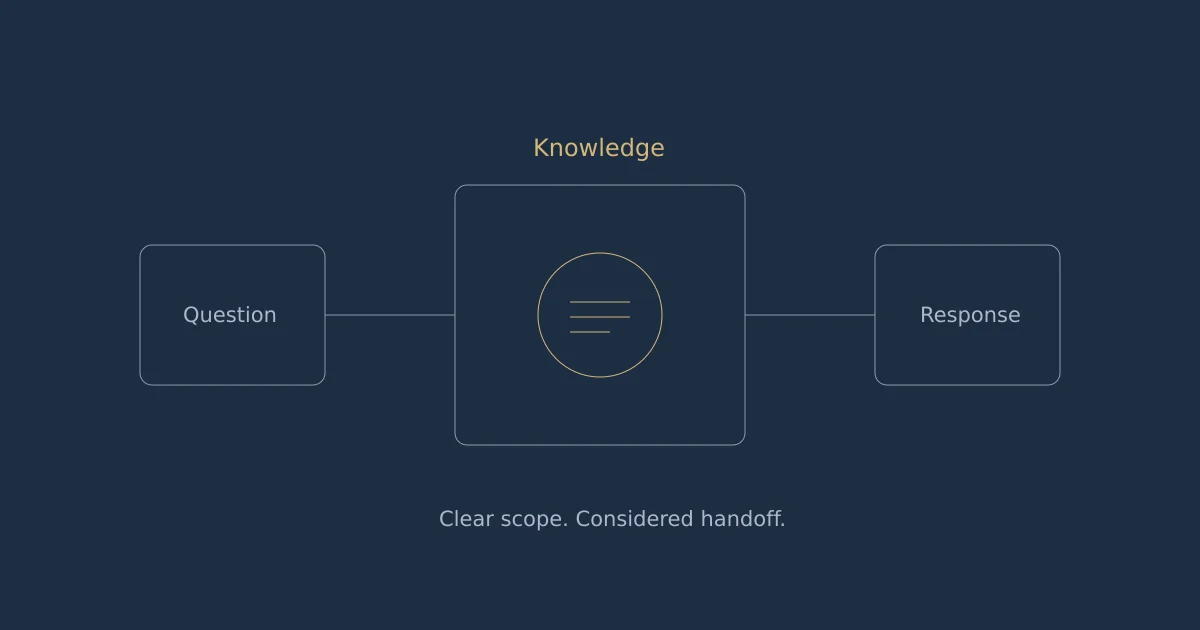
An assistant should use approved sources relevant to a bounded task. Knowledge needs ownership and an update process, while answers should be tested against their sources.
Provide a human route for unsupported, ambiguous, sensitive or high-impact requests and situations outside the task. Explain the next step and any information that may be transferred.
Evaluate realistic conversations for source support, answer accuracy, task completion, accessibility and recovery from failure. Do not treat fluent language or a feature list as evidence of reliability.
Understand how AI assistants combine conversation, reliable knowledge and defined tasks—and why boundaries and human handoff matter.
Read articleHuman handoff gives someone a route from an automated assistant to an appropriate person, with clear expectations about what happens next.
Read definitionHave a relevant idea or collaboration in mind? Tell us what you’re working on and the connection you see.