What Is Human Handoff?
Human handoff gives someone a route from an automated assistant to an appropriate person, with clear expectations about what happens next.
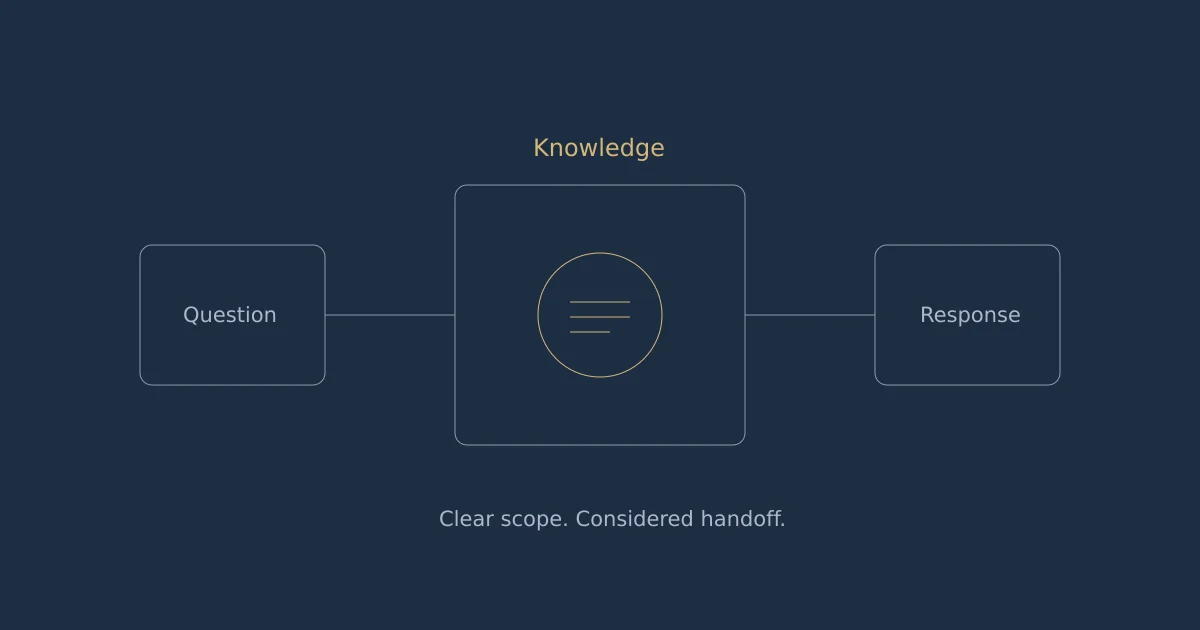
Human handoff is the transition from an automated interaction to an appropriate person or human-managed channel. It gives someone a practical next step when a system cannot or should not continue on its own.
When it is useful
A handoff may be appropriate when the question falls outside approved knowledge, a response is disputed, sensitive information is involved or a person explicitly asks for help. The appropriate route depends on the system and the context.
Handoff does not have to mean instant live chat. It could lead to an email address or another supported process. What matters is that the route works and the expectations are accurate.
What a clear handoff explains
Tell the user where they are going, what information will be shared and what to expect next. Do not imply that a person is available immediately unless that availability is confirmed. Ask for only the information needed for the transition.
For example, a knowledge assistant could stop when a request needs a commercial decision and offer the organisation’s public contact address. This is an illustrative pattern, not a claim about an available AISA assistant.
Why it matters
A visible route to a human supports recovery when an automated answer is incomplete or unsuitable. It is one part of responsible operation, alongside knowledge quality, evaluation and clear limits.
Read What Is an AI Smart Assistant? for the broader relationship between a defined task, reliable knowledge and oversight.