SEO vs AEO vs GEO vs AIO: A Practical Guide
Compare SEO, AEO, GEO and AIO, understand their shared foundations, and improve search and AI discoverability with clear answers, sources and realistic limits.
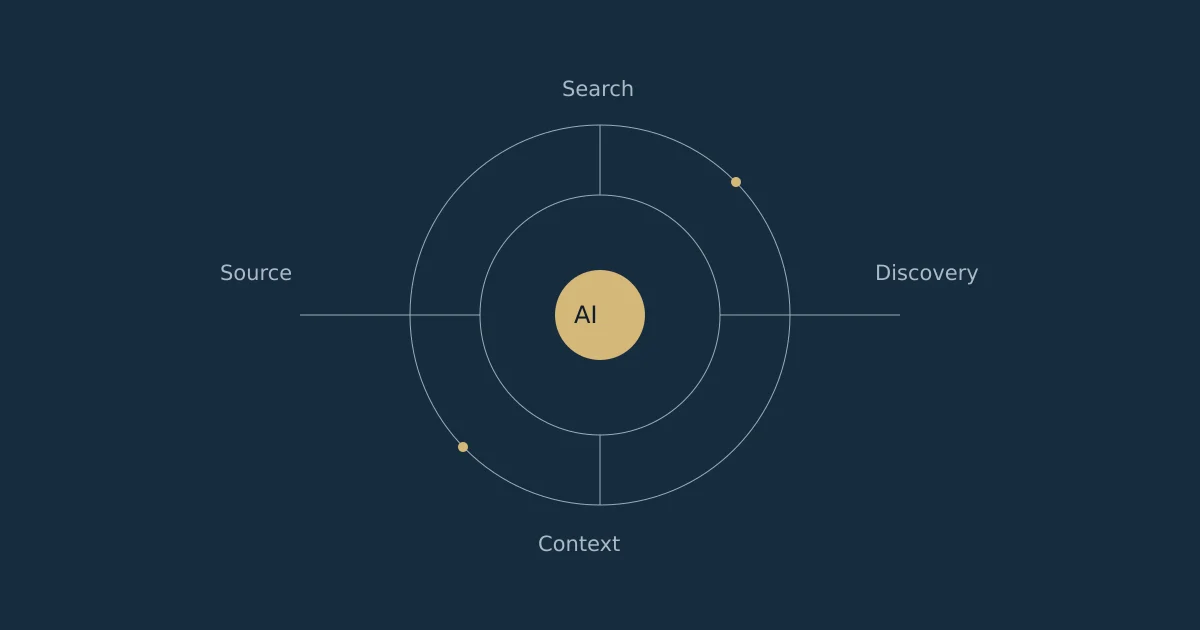
SEO, AEO and GEO describe overlapping ways of thinking about digital discoverability. SEO focuses on search engine visibility. AEO emphasises content that answers questions clearly. GEO considers how information may be found and referenced in AI-generated responses. The boundaries are informal and usage varies.
For a business or publisher, the most useful starting point is a technically accessible website with accurate, well-organised content. A new acronym does not remove the need for those foundations.
What the terms mean
Search Engine Optimization (SEO) is the practice of improving a website’s ability to be discovered and understood through search engines. It includes technical access, content relevance, internal relationships and the experience of using the pages.
Answer Engine Optimization (AEO) is an industry term for structuring useful information so that a question can be answered directly. Clear definitions, descriptive headings and concise explanations are common approaches. There is no single universal AEO specification.
Generative Engine Optimization (GEO) is an industry term for improving the discoverability and usefulness of information in experiences that generate answers from multiple sources. It commonly involves entity clarity, useful source material and transparent evidence. It does not provide control over whether a model references a page.
These are working definitions for this guide. They should not be mistaken for separate official programmes offered by search platforms.
Where does AIO fit?
AIO is used inconsistently for AI optimization or optimization for AI Overviews. In this guide, AIO refers to preparing useful information for AI-assisted discovery, including AI Overviews, rather than a separate technical specification. Define the term when discussing a project so that its scope is clear.
For AI Overviews and AI Mode, Google’s documented SEO foundations still apply. Work on clear answers, reliable sources, ordinary crawlable links and page usability. There is no special AI schema that can guarantee inclusion.
Compare the questions each approach asks
| Perspective | Useful question | Practical work |
|---|---|---|
| SEO | Can a search engine find and understand the relevant page? | Crawl access, architecture, relevance and page usability |
| AEO | Can a reader quickly identify a clear answer? | Direct definitions, descriptive headings and useful examples |
| GEO | Is the information clear and dependable enough to reference? | Source attribution, entity consistency and factual context |
A single guide can address all three. For example, a publisher explaining structured data can use a crawlable page, put a plain-language definition near the beginning and link to the relevant primary documentation. Those improvements serve readers even if an AI system never cites the page.
Keep the technical foundation intact
Check that important pages return the correct status, use consistent canonical URLs and can be reached through normal links. Render essential content as HTML. Avoid hiding all meaningful information behind an interaction or an image.
Use structured data when it accurately describes visible content. An article can identify its title, publisher and dates. A glossary page can identify a defined term. Adding unsupported ratings, fabricated credentials or misleading product claims weakens the information rather than improving it.
Technical work creates eligibility and accessibility. It cannot make a weak page useful, and it cannot guarantee a ranking or citation.
Make the answer easy to understand
Begin with the question the page actually answers. Give the essential explanation early, then add the distinctions a reader needs to apply it correctly.
A clear definition usually needs context. “Attribution allocates credit” is a useful beginning, but a reader also needs to know that allocating credit is different from proving causation. Concision should remove repetition, not the caveats that make an answer dependable.
Use examples that are explicitly illustrative. If you have not tested a product, conducted original research or observed an outcome, do not write as though you have. Link related concepts where the relationship helps someone understand the current page.
What Google says about AI features
Google’s guidance on AI features says that existing SEO fundamentals remain relevant and that no additional technical requirements are needed specifically for inclusion in its AI features. It does not promise that an eligible page will appear.
This supports a practical inference: focus first on content quality and technical access rather than assuming a separate “AI-only” implementation will solve discoverability. Other platforms have their own systems and policies, so Google’s guidance should not be treated as a universal statement about every AI product.
Separate AI search access from model training
OpenAI’s crawler documentation distinguishes OAI-SearchBot, which supports search discovery, from GPTBot, which concerns model training. Its controls can be set independently. Check the purpose of each provider’s agents rather than assuming all AI crawling serves the same purpose.
Hosting and CDN controls matter alongside robots.txt. A publicly accessible page with useful content is a foundation for discovery, while an optional content directory such as llms.txt is not a requirement for Google’s AI features.
Measure with appropriate limits
Search impressions, clicks, referral visits and enquiries answer different questions. A page can appear without receiving a click; a useful visit can happen without producing an immediate enquiry. A user may return later through a different channel.
If you sample AI answers, record the platform, date, question wording and any available context. Treat the result as an observation under those conditions. It is not a stable ranking for all people and prompts.
Combine available platform reporting with first-party evidence and editorial review. Avoid presenting a citation count, visibility score or traffic change as a complete account of business value. Our guide to measuring discovery develops this distinction.
A practical starting sequence
- Identify an important audience question and its appropriate page.
- Check that the page can be accessed, linked and understood.
- Give a direct answer with necessary context and limitations.
- Review factual statements against current primary sources.
- Link to related concepts where they help the reader.
- Define a useful outcome and monitor the evidence over time.
SEO, AEO and GEO are useful lenses when they improve the work. The goal is information that people can find, understand and use—not a collection of labels attached to the same page.